
Rules and ethics
Cardiff paid-social bids for Welsh public-sector buyers: bilingual creative and procurement
How agencies bidding for Cardiff and Welsh public-sector paid-social work can prepare bilingual creative, procurement answers, spend reporting and exit terms.
Cardiff paid-social bids for Welsh public-sector buyers: bilingual creative and procurement
Mistake: Waiting until production to settle Welsh approval
The costliest mistake is commissioning layouts before the buyer confirms who supplies, reviews and approves Welsh copy. What goes wrong is late translation, mismatched assets and rework. The buyer holds the language duty, while the agency carries practical delivery risk. Fix the approval route before production begins.
Welsh and English versions should be built to the same standard, rather than treated as different levels of finish. Buyers usually require both languages and may expect Welsh to lead for Welsh-language audiences. The buyer's Welsh language officer or translation unit normally has final say, so involve that team before layouts are locked.
Bilingual approval sequence
- Agree assets needing Welsh and English
- Buyer's translation unit approves Welsh copy
- Lock copy before design
- Build both variants in same ad set
- Get written sign-off from named approver
- Agree which assets need Welsh and English versions, and which need Welsh only.
- Ask the buyer's translation unit to supply or approve the Welsh copy.
- Lock the copy before design, so line lengths and button text do not break.
- Build both variants in the same ad set structure, using matched naming conventions.
- Obtain written sign-off on both language versions from the named approver.
Welsh is often longer than English, so a headline that fits one version can truncate in the other. Test both variants in the platform preview before presenting them to the buyer. A bilingual creative production plan should leave enough time for the translation team to review tone and request changes.
Tone can shift too: a direct English call to action may sound abrupt in Welsh. The buyer's translation team can catch that only if it sees the copy early. Keep a written record of who approved each version and when, giving the buyer an approval trail if a complaint arrives.
Mistake: Sending Cardiff a generic UK bid
Cardiff is not a generic UK market: Welsh Government, Cardiff Council, Cardiff and Vale University Health Board, Public Health Wales, Transport for Wales, universities and arm's-length bodies operate within a few miles of agencies pitching to them.
A bid that could have been sent to any city misses this close-knit buyer context.
Buyers know one another, so a weak submission can travel beyond its first recipient. Keep Wales Safe illustrates bilingual public messaging at scale. A buyer may have a Welsh Language Standards compliance notice, while finance teams seek audit trails and communications leads answer to a board or minister.
Fix the generic-bid problem by connecting language duties, finance controls and approval roles to that organisation's governance and campaign aims. A buyer-specific audience definition can help frame the organisation and decision role; respond to the buyer's own requirements rather than relying on a city-wide pitch.
Mistake: Checking the advert but missing the wider controls
Treating one advert review as complete clearance can miss Welsh language requirements, public spending controls, procurement rules and the buyer's internal approvals. The buyer holds the legal duty, but the agency still carries practical delivery risk. Map each check, its owner and its release point before scheduling content.
The relevant instruments and controls include:
- The Welsh Language (Wales) Measure 2011 and the Welsh Language Standards made under it.
- The Public Contracts Regulations 2015 and, from 24 February 2025, the Procurement Act 2023.
- Managing Welsh Public Money spending controls, alongside UK advertising codes enforced by the ASA.
The Welsh Language Standards sit alongside procurement and public spending controls. For content close to public policy, the ASA's Social and political category is a starting point. A Welsh devolved campaign resembling a party political broadcast may attract attention the buyer did not plan for.
The CAP Code applies to adverts shown to Welsh audiences, whatever the devolved context. Treat it as the floor, then check the code and relevant sector guidance before release. The ASA's resource library supports pre-release checks, while Advice for businesses from ASA and CAP explains how the code applies to specific claims.
A pre-release advert check is a useful habit for Welsh teams because the sequence and failure points are similar. Welsh Government communications teams, council press offices and health board communications leads add their own checks. Agree who signs off before anything is booked or scheduled.
Mistake: Treating procurement as a credentials exercise
A bid can fail when it describes agency experience but does not answer the buyer's scored questions. Evaluators then cannot see how the work will be delivered or governed. Fix this by answering each published criterion with evidence, named owners and a clear route to delivery.
Most Welsh public-sector paid-social work is bought through the Welsh Government's Media Buying Services framework or a competitive tender. Sell2Wales is the notice board for contracts above £25,000, while eTenderWales runs the tender. Some work is bought through open tender or a mini-competition under an existing framework; smaller contracts may sit below the threshold for a full process.
For contracts above current procurement thresholds, notices also go to Find a Tender: £139,000 applies to central government goods and services, and £214,000 to sub-central bodies. Larger bodies may also run mini-competitions under an existing framework.
Evaluation usually splits between quality and price, with quality weighted heavily for communications work. Buyers score written answers against published criteria, so answer the question asked rather than restating credentials. An evidence-led evaluation approach helps make each response specific and verifiable.
Typical scored criteria include:
Procurement evaluation criteria
- Understanding of the buyer's audience and objectives
- Approach to bilingual creative and approval
- Media planning and channel choice
- Measurement, reporting and spend reconciliation
- Team, named leads and contingency
- Social value and fair work practices, where the buyer applies them
Award is not the end of the process. Public buyers increasingly include a pilot phase and a defined exit; the structure is sometimes described as vetoes, a pilot and an exit test before award. Trading obligations matter too: Companies House filings, VAT registration and insurance are checked, with relevant information under Business and self-employed on GOV.UK.
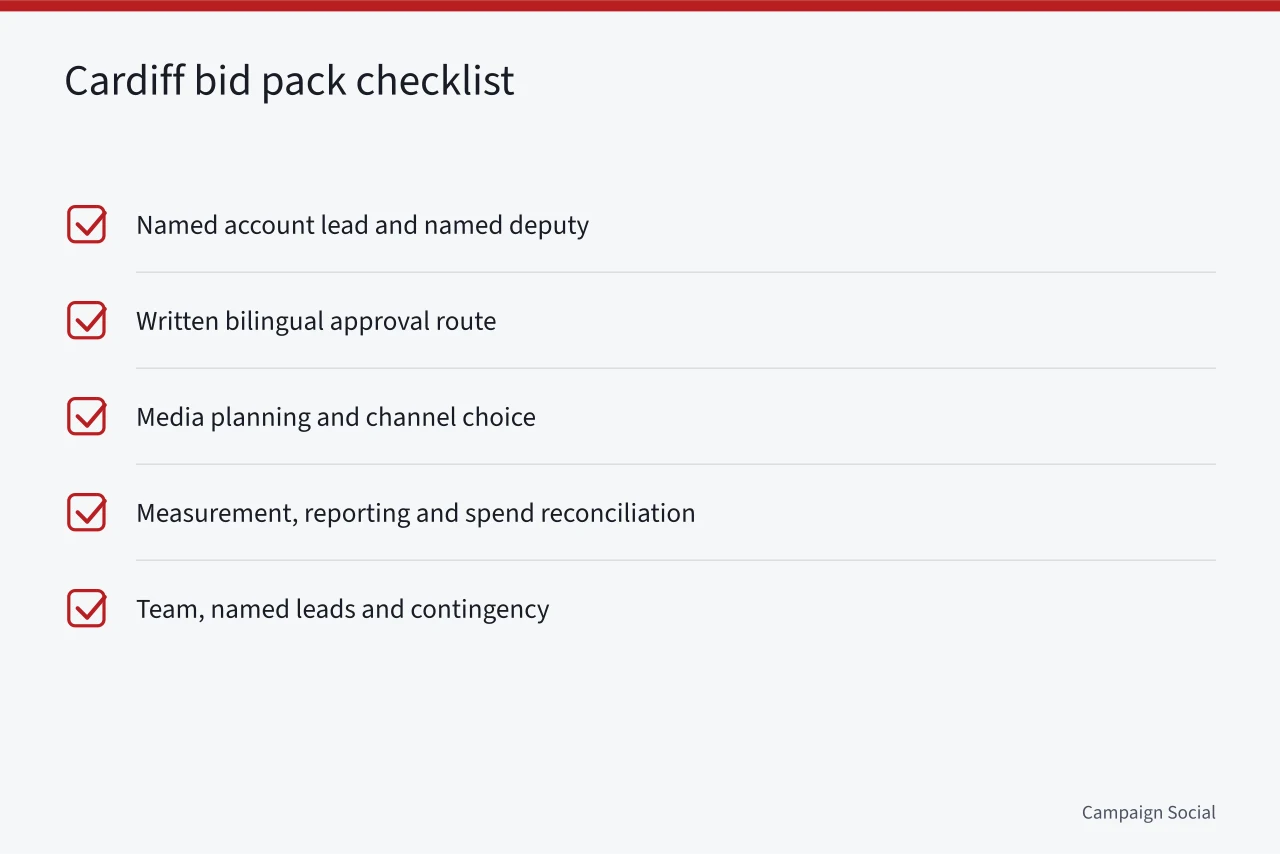
A bid checklist can make delivery responsibilities visible:
- Named account lead and named deputy
- Written bilingual approval route with the buyer's translation unit
- Media plan with channel rationale and budget split
- Reporting sample showing spend reconciliation
- Baseline metrics and how success will be judged
- Exit plan and data handover terms
- Confirmation of insurance, VAT status and company filings
Mistake: Reporting attention without reconciling spend
A report limited to impressions and engagement cannot support a public buyer's account of money spent. Finance teams may be unable to match campaign costs to their records. Report media cost, management fee and production or translation costs separately, then reconcile those amounts to platform invoices.
Spend reporting requirements
- Reconcile platform invoices to finance records
- Separate media cost line
- Separate management fee line
- Separate production and translation cost line
- Metric cards with clocks
- Monthly reporting, weekly during live push
Paid-social spend reporting should reconcile platform invoices to the buyer's own finance records. Keep media cost, management fee, and any production or translation cost on separate lines. This gives the buyer a report that supports its governance instead of engagement figures detached from expenditure.
Build the report as metric cards with clocks: each card names one measure, its target and the review point. Google Ads, Meta Ads Manager and TikTok publish ad libraries that buyers or auditors can check independently, so differences between reported figures and library information can prompt questions.
Monthly reporting suits most campaigns, while a short weekly note during a live push can prevent end-of-campaign surprises. Flag underperformance early: a buyer would rather hear in week two that a channel is not working than discover it in the final report after the budget has gone.
Mistake: Leaving ownership, baselines and exit terms vague
When people, baselines and exit terms are unnamed, a bid becomes hard to evaluate and a contract harder to hand over. Buyers cannot see accountable ownership or how results will be judged. Identify a lead and deputy, define a baseline, and state how data, accounts and creative assets transfer.
Common gaps include no named person to approve Welsh copy, translation treated as an afterthought, reporting that stops at engagement and no baseline for judging performance. A named account lead and a written approval route clarify ownership; a baseline makes it possible to assess whether the campaign worked.
A translation budget is not the same as an approval route. Buyers want Welsh planned from the start, and they need clear exit terms covering data, accounts and creative assets. Use contract terms to spell out the handover rather than leaving transfer arrangements until the contract ends.
Welsh Language Standards and the CAP Code sit alongside each other: the CAP Code applies to adverts shown to Welsh audiences, while language standards and public spending controls add requirements the buyer must meet. A framework is not the only route into this work; open tenders, mini-competitions and smaller contracts below a full-process threshold are also possible.